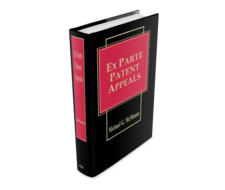
Expected late fall. Pre-order your copy now!
Ex Parte Patent Appeals describes and explains the procedural and substantive law applicable to ex parte patent appeals. It is intended to assist attorneys in drafting their appeals.
While ex parte appellate practice bears similarities to both patent prosecution and judicial appellate practice, it is, ultimately, its own category. This book is for busy patent practitioners who spend most of their time drafting patents, working with clients, and interacting with patent examiners, or for those who only draft one or two appeals per year.
The book frequently cites both precedential and “routine” Board decisions and likely includes more citations to nonprecedential Board decisions than any work ever published, as it seeks to go beyond curated precedential decisions and give practitioners real insight into how a given argument will be received at the Board.
Michael G. McManus is a former Administrative Patent Judge at the US Patent and Trademark Office where he served for nine years from 2016 to 2025.
After years of working for Customs and Border Protection (then US Customs) in DC, and then for several Washington DC law firms learning IP litigation in the district courts and before the International Trade Commission, Michael G. McManus accepted an appointment from the Secretary of Commerce to serve as an Administrative Patent Judge on the Patent Trial and Appeal Board (PTAB). There, he worked on both ex parte appeals (that is, patent applicants’ appeals of Patent Examiner rejections) and inter partes reviews (also known as IPRs, where the Patent Office is asked to take a second look at whether a patent is valid over the prior art). While at the Patent Office, he was selected to serve on a long-term detail at the International Trade Commission. There, he had the great experience of working as an aide to Commissioner (and later, Chairman) David Johanson. In 2024, he returned to the Board where he continued to work on ex parte appeals and IPRs.
Judge McManus returned to the private sector in 2025. After a brief stint with a firm concentrating on district court litigation, he decided to pursue his dream since law school of launching his own practice with a Washington focus.